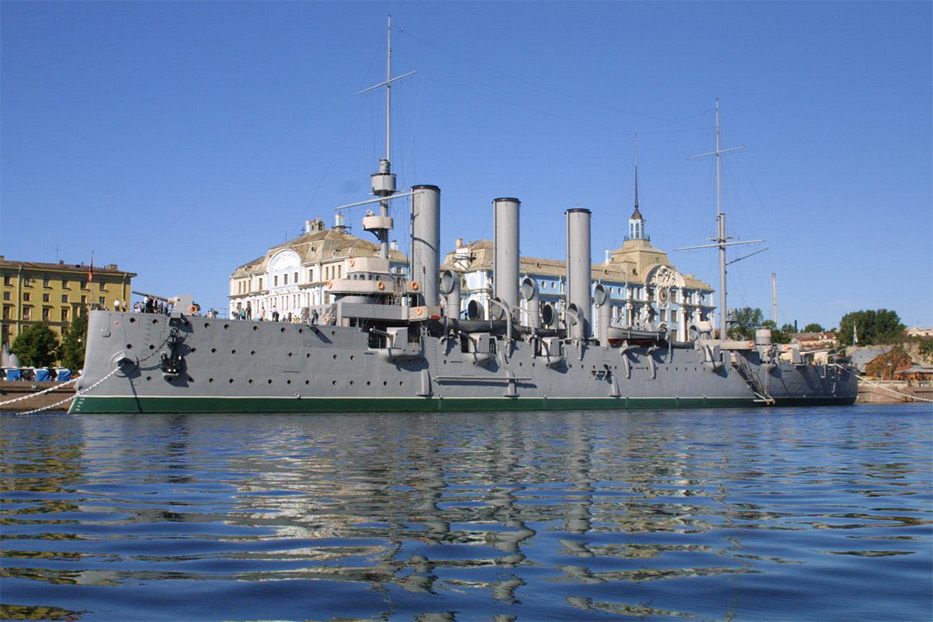
Aurora

The Aurora is a cruiser of Russian origin that was taken into service around 1901 in the Russian Navy. It is one of the first naval ships built in Russia. Before this time they were built in England where they could be realized faster and cheaper. However, due to increasing tensions between Russia and England, this was no longer an option ….

The Aurora has seen action for the first time in the Russian-Japanese war, and the last deployment was during the Second World War where her guns played an important role during the siege of St. Petersburg (then Leningrad).

The most famous piece of history of the Aurora is her role in the Russian revolution of 1917 where she announced the start of the revolution with a cannon shot.

The report is divided into groups and, if necessary, commented …

0 - Preparation

The preparation consists of collecting drawings and photographs. The drawings are of poor quality, later many photos and a book have been added to make more details available.

1 - The hull part one

The beginning of construction a ship starts with the rafters that determine the shape of the hull. With the necessary bumps, the shape of the ship was finally realized. This report tells what went well, but certainly what went wrong ...

2 - The hull part two

Further finishing of the hull starting with the stabilization fins after which the propeller shafts and rudder support are added..

3 - The Deck

The realization of the deck. The original intent was to cover these with separate slats, but the scale turned out to be much too small to realize this. The alternative was to draw ...

4 - The boarding

Now that the deck has been placed, the boarding can be finished. For this, certain parts of the wooden boarding have been replaced by styrene as an extension of the hull, and the inside of all boarding is also provided with styrene details.

5 - Rudder and propellors

That it was a first scratch project became completely clear during the making of the propellers. Here are a limited number of attempts telling me that this is not the way to make propellers. It ultimately led to a desired result.

6 - Finishing the edge of the deck

The deck must still be finished on the hull after which the 'swallow nests' can be applied.

7 - Superstructure part 1

The first steps in manufacturing the superstructure.

8 - Detailing the hull

Now that the shape of the hull is ready, the details can be applied. This includes, among other things: approximately 180 portholes, 16 drains, various brackets, anchors, etc.